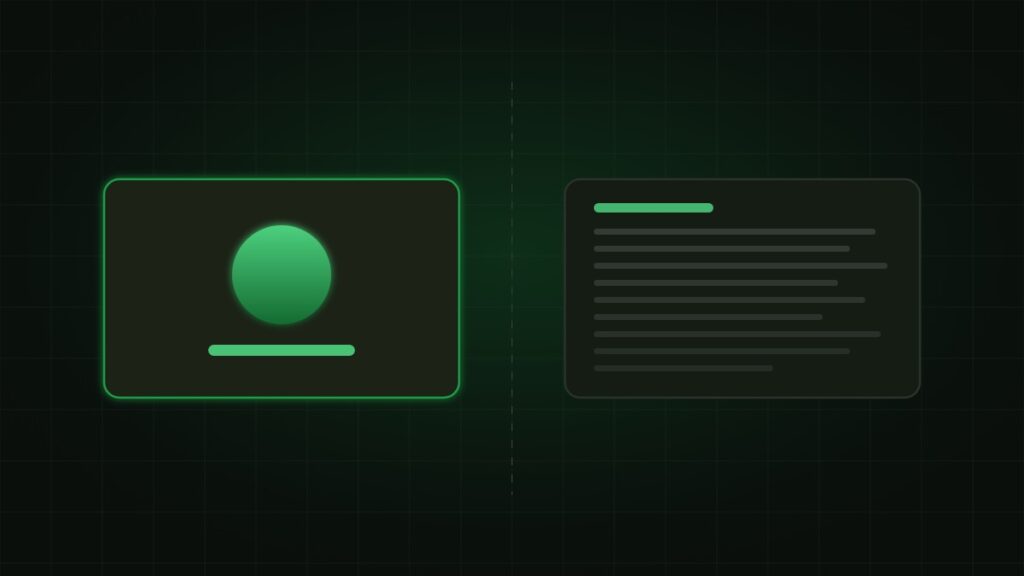
Most people build one deck and use it for everything. They present it on a call, then email the same file afterwards as a follow-up.
It feels efficient. It is the most common reason a pitch that went well in the room goes quiet afterwards. The deck you talk over and the deck you send have opposite jobs, and a file that does one well almost always does the other badly.
Why one deck cannot do both
When you present, you are the explanation. The slide exists to hold attention on one idea while you supply the context, the caveats and the story. Text on screen actively works against you, because people read faster than you speak and stop listening while they do it.
When someone opens that same file three days later, you are not there. Every piece of context you supplied out loud has vanished. What is left is a sequence of bold statements and striking images with nothing explaining them, which reads as vague rather than confident.
The reverse fails just as reliably. A document dense enough to stand alone, projected on a screen while you read from it, is the single most effective way to lose a room.
The presenting deck: you are the narration
This version is built for a live audience with you talking. Its job is to keep attention where you want it and give people something to hold onto.
- One idea per slide. If a slide makes two points, it is two slides. Slides are free.
- Very little text. A short headline that states the point, and almost nothing else. No bullet lists that duplicate what you are about to say.
- Large type. Readable from the back of a room, and readable in a small video call window.
- One number at a time. If a slide has a key figure, make it enormous and let it sit alone.
- Charts stripped to the point. Remove gridlines, secondary series and anything you will not actually mention.
The test: if someone reads this deck without you, they should find it almost empty. That is correct. It is not finished work, it is a set of prompts.
The leave-behind deck: it has to survive being read alone
This version gets forwarded to people who were never in the room, and that is the point. Decisions are rarely made by the person you pitched. They are made later, by a group, using whatever file got circulated.
- Every claim carries its evidence. If you said it out loud, write it down.
- Headlines state conclusions. Not Revenue Growth, but Revenue tripled in eighteen months on flat headcount. A reader skimming only the headlines should get the whole argument.
- Charts are labelled directly. Annotate the insight on the chart itself rather than relying on a caption nobody reads.
- Add the obvious questions. The three things you always get asked should already be answered, usually in an appendix.
- It works on a phone. A good proportion of first reads happen on a phone. Eight point footnotes do not survive that.
The same slide, built both ways
Take a traction slide for a business that grew from forty customers to two hundred and sixty in a year, with most of the growth from referrals.
Presenting version. A single line chart, no axis clutter, and one headline: 40 to 260 customers in twelve months. That is the entire slide. You supply the rest: that referrals drove most of it, that you spent almost nothing on acquisition, that the dip in July was a deliberate pause while you rebuilt onboarding.
Leave-behind version. The same chart, now annotated. The July dip is labelled with its one-line explanation. A small breakdown shows referral against paid against direct. The headline becomes 40 to 260 customers in twelve months, 71 percent from referral. A short note underneath gives the acquisition cost. Nothing has been made prettier. The context you would have spoken is now written down.
Same underlying evidence, same design language, two genuinely different documents.
What usually goes wrong
Sending the presenting deck. The most common error by a distance. The recipient opens a file of bold claims with no support, and the meeting that felt strong converts into nothing. They are not being difficult. They genuinely cannot see what you meant.
Presenting the leave-behind. You end up reading your own slides aloud while everyone silently reads ahead and finishes before you. Attention is gone by slide four.
Splitting the difference. The worst outcome, and the most common compromise. A deck with moderate text everywhere is too busy to present and too thin to stand alone, so it fails at both jobs rather than one.
How to build both without doubling the work
You are not making two decks. You are making one and then producing a second version of it.
Build the leave-behind first. It forces you to prove every claim while you still have the evidence in front of you, and it surfaces the arguments that do not actually hold up. Then duplicate it and strip it down: delete body text, enlarge headlines, cut each slide to one idea, and move the detail you removed into an appendix.
The second pass is usually an hour or two, not another project, and it is far faster than trying to add rigour to a sparse deck after the fact. Keep one source of truth for the numbers so the two versions cannot drift apart.
A two-minute check on the deck you have now
Open your current deck and run through these. They are quick, and they are usually conclusive.
- Read only the headlines, in order. If that alone tells a coherent story, you have a workable leave-behind. If it reads as a list of topics, you do not.
- Hand it to someone who has never heard the pitch. Give them four minutes and no explanation, then ask what you do and why it will work. Their answer is what your deck actually says.
- Open it on your phone. Anything you cannot read without zooming is not in the deck as far as a real reader is concerned.
- Count the slides you would talk over for more than ninety seconds. Each one is probably two or three slides in the presenting version.
- Find your single best piece of evidence. If it appears after slide six, it is too late. Move it forward.
If the deck fails the first two checks but passes the rest, you almost certainly have the compromise version, and splitting it will do more for your conversion rate than any amount of redesign.
Common questions
Can I just add speaker notes instead?
Speaker notes solve your problem, not the reader’s. They are usually invisible in the exported PDF and almost nobody opens the notes pane. Useful for rehearsal, not a substitute for a leave-behind.
Which one goes in the data room?
The leave-behind, always. Anything read without you present should be the self-contained version.
What about a cold outreach deck?
That is a leave-behind by definition, since nobody is narrating it. Keep it shorter than the one you send after a meeting, because you have not earned the attention yet.
Does this apply outside fundraising?
Yes, and arguably more so. Sales proposals, board updates and internal business cases all get forwarded to people who were not in the room. Anywhere a decision is made after the meeting, the split is worth making.
If your deck is doing both jobs badly
Most decks we are sent are the compromise version, and the owners usually know something is off without being able to name it.
If you are not sure which of the two you currently have, that is worth knowing before your next meeting. Our pitch deck and presentation work covers both versions as standard, and if you want the underlying argument checked first, start with what investors actually look for in a deck.
Send us what you have and we will tell you which deck you have built.