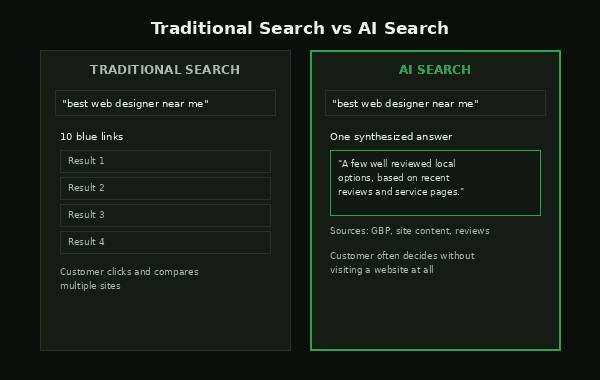
Most people who search for a business today never click a single link. Google, ChatGPT, Gemini, and Perplexity now use AI search to answer the question directly on the results page, pulling information from websites, reviews, and directories and presenting it as one summarized answer. If your business isn’t clearly described somewhere those systems can read, you’re invisible in the exact moment a customer is ready to buy.
This shift has a name: AI search, or generative search. It isn’t a future trend anymore. It’s already changing which plumbers, dentists, boutiques, and agencies get chosen, and it’s rewriting the rules that small business owners have followed for the last two decades of SEO.
What Is AI Search, Exactly
AI search refers to any search experience where an AI model generates a written answer instead of, or in addition to, a list of links. This includes:
- Google AI Overviews, the AI generated summary that now appears above traditional results for a huge share of searches
- AI chatbots used as search engines, since ChatGPT, Gemini, Claude, and Copilot are increasingly used the way people used to use Google
- Answer engines like Perplexity, built specifically to research a question and hand back a sourced summary
In every case, the AI is doing the same basic job. It reads content from many sources, decides what’s accurate and trustworthy, and writes a new answer in its own words. Sometimes it links to the original source. Often, it doesn’t, which means the user gets an answer and never visits your website at all.
Why This Matters More for Small Businesses Than Big Brands
Large national brands already have decades of reviews, press mentions, and backlinks feeding these AI systems. Small and local businesses are the ones with the most to gain, and the most to lose, because:
- Local intent is where AI search shows up first. Questions like “who’s the best accountant in town” or “which agency redesigns websites for small businesses” are exactly the kind of specific, local, comparison heavy queries that trigger an AI generated answer instead of a plain list of links.
- Trust signals now do double duty. Your Google Business Profile, your reviews, and your service pages aren’t just for human visitors anymore. They’re the raw material an AI model uses to decide if you’re worth recommending.
- The businesses that show up in the answer get the call. If an AI overview names three landscaping companies and yours isn’t one of them, the customer typically doesn’t scroll further to find you. They call one of the three.
How AI Search Systems Decide Who Gets Mentioned
AI search tools aren’t ranking pages the way classic Google search does. They’re trying to answer a question accurately and confidently, which means they favor content that is:
- Specific rather than vague. A page that says “we build custom websites for small businesses in dentistry, retail, and home services” is easier for an AI to match to a specific query than a page that just says “we build beautiful websites.”
- Structured so it can be pulled apart. Clear headings, short paragraphs, and direct answers near the top of the page are far easier for a model to extract and quote than a long, unbroken block of marketing copy.
- Backed by consistent information everywhere. If your business name, service list, and location match across your website, Google Business Profile, and directory listings, that consistency builds the confidence an AI model needs before it recommends you.
- Supported by outside proof. Reviews, mentions on other sites, and citations from directories or local publications all act as evidence that your business is real, active, and trustworthy.
What This Means for Your Website Right Now
The good news is that most of what makes a website ready for AI search is the same thing that makes it good for customers and good for traditional SEO. A few priorities matter more than they used to.
Answer the question in the first few sentences
AI models tend to pull from the part of a page that answers the query most directly, which is usually near the top. Instead of opening a service page with a story about your company’s history, open with what the service is, who it’s for, and what problem it solves.
Break content into clear, labeled sections
Headings that match how people actually ask questions, such as “How much does a website redesign cost” instead of “Our Process”, make it far easier for an AI system to find and lift the relevant answer.
Keep your Google Business Profile complete and current
This single listing feeds an enormous amount of what AI search shows for local queries. Business hours, categories, services, photos, and recent posts all matter more in an AI first search environment than they used to. Google’s own guide on establishing your business details walks through what to keep current.
Collect and respond to reviews consistently
Review volume, recency, and content are treated as trust signals by both traditional search and AI search. A steady stream of recent, detailed reviews tells an AI model your business is active and reliable right now, not just in the past.
Use structured data, also known as schema markup
Schema is a way of labeling your content so machines, not just humans, can understand it clearly. Marking up your services, FAQs, reviews, and business information helps AI systems parse your site with far less guesswork. Google’s introduction to structured data is a good starting point if your developer hasn’t implemented it yet. Google has also confirmed in its own guidance on AI features that the same foundational SEO practices apply to showing up in AI Overviews and AI Mode.
The Businesses Winning at AI Search Right Now
The pattern is consistent across industries. Businesses that are gaining visibility in AI search tend to share three habits: they publish specific, practical content that answers real customer questions instead of generic marketing copy, they keep their online information consistent and current across their website, Google Business Profile, directories, and social profiles, and they treat reviews as an ongoing part of marketing rather than an afterthought.
None of this requires a massive budget or a total rebuild. It requires being deliberate about how your business is described everywhere it shows up online.
Frequently Asked Questions
Does AI search mean traditional SEO doesn’t matter anymore?
No. AI search and traditional SEO share the same foundation: a fast, well structured, trustworthy website with clear content. AI search adds new priorities on top of that foundation, like answer first writing and consistent information across platforms, rather than replacing it.
Will my business show up in ChatGPT or Gemini if I haven’t done anything special?
Possibly, if your website and business listings already have clear, consistent information. But businesses that actively optimize for these systems, through structured content, complete profiles, and active reviews, show up far more often and more accurately than those that don’t.
How long does it take to see results from AI search optimization?
Because AI models frequently refresh what they know from the web, well structured, consistent updates can start influencing results in weeks rather than the months traditional SEO sometimes takes. Consistency over time still matters most.
Is AI search only relevant to big companies with large marketing budgets?
It’s actually the opposite. Local and small businesses often benefit the most, because AI search rewards specific, trustworthy, well organized information, which is achievable without a massive budget or a large content team.
Getting Your Business Ready for the Way People Search Now
AI search isn’t a passing trend. It’s becoming the default way people research local businesses, compare services, and make decisions before they ever pick up the phone. The businesses that adapt now, by cleaning up their online information, structuring their content clearly, and building a steady stream of trust signals, will be the ones showing up in the answer instead of getting left out of it.
If you’re not sure whether your website and online listings are set up to be found this way, that’s exactly where a proper audit starts. Our SEO services and full range of services are built around exactly this shift, and our team can review your current site and show you precisely where the gaps are.